The truth about divergent souls in a conformist world - Lian Brook-Tyler
Episode 534, released 4th February 2026.
This episode is Lian’s All The Everything show… her solo space where she dives deeply into a theme that is alive for her, which, if you know her work, could move anywhere… from the most scientific to the most spiritual, and very often a weaving of both… which is exactly why the show carries its name.
It is created for those who feel called toward a soulful life shaped by meaning, depth, truth, and love… for those who feel unsatisfied with quick answers or surface level takes. This is a rich rabbit hole that Lian journeys through alongside you. She speaks from her own lived experience and unfolding process… while inviting you into your own as you listen.
The intention is that you leave feeling less alone in your seeking… more oriented within your life… and more able to trust what you already sense is true. Listeners often share that they leave these conversations feeling more settled, clearer, and more deeply connected to what matters most… both within themselves and in the world around them.
Listen or watch on:




Or if you prefer to read: Scroll right down for the transcript
The LIVE making of All The Everything is recorded live on YouTube… to join Lian for the next one: Make sure you’re subscribed to our YouTube channel, subscribed to our Moonly News email list and/or are a member of our Facebook group and we’ll let you know when the next one is happening.
In this episode, Lian, explores a question that can split a life in two… are you here to conform, or are you here to diverge? She speaks to the moment you realise you cannot keep shaping yourself to fit, the cost of going along when something inside you is saying no, and what happens when you finally stop pretending that path is yours.
From there, she follows the deeper pattern beneath it… The ancient roots of the words themselves, a stark 1950s experiment that shows how easily humans deny what they can clearly see, and figures like Socrates and Joan of Arc who answered an inner call that would not let them stay inside the lines. The conversation moves into the real price of divergence… grief, rupture, being misunderstood, and why “find the others” is not poetry, it is survival.
Listen if you have ever stayed silent to belong, then felt the hollowing afterwards, or sensed your soul asking for a life that costs more and gives more.
We’d love to know what YOU think about this week’s show. Let’s carry on the conversation… please leave a comment below.
What you’ll receive from this episode:
How group pressure makes people say what they know is untrue, and what this reveals about conformists, divergents, and the ones caught between
Why divergence is not about being difficult or different, but about an inner truth that will not be negotiated
What becomes possible when you stop waiting for permission, claim your own authority, and let your truth be your vital role in the community
Resources and stuff Lian spoke about:
Make sure you’re subscribed to our YouTube channel, subscribed to our Moonly News email list and/or are a member of our Facebook group and we’ll let you know when the next one is happening.
Register your interest for the upcoming Wild Sovereign Soul journey here.
Share what showed up for you listening to this show, including any questions, either in the Be Mythical facebook group or in UNIO.
Join UNIO, The Community for Wild Sovereign Souls: This is for the old souls in this new world… Discover your kin & unite with your soul’s calling to truly live your myth.
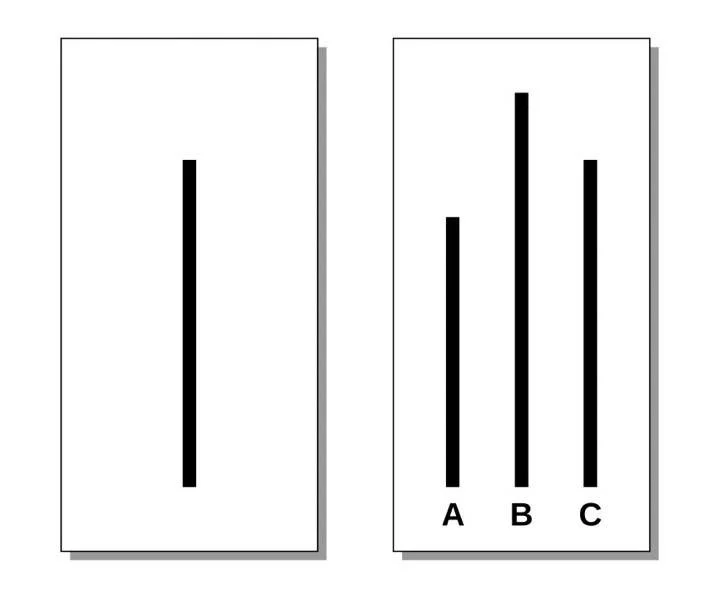
The Asch paradigm - these were the cards used in the study spoken about during the show.
Don’t want to miss a thing?
Subscribe (BTW, it’s absolutely FREE) to the show on your favourite platform or app by clicking the relevant button below… That way you’ll receive each episode automagically straight to your device as soon as it’s released!




Thank you!
Lian & Jonathan
Episode Transcript:
Please note: We are a small team and not able to check through the transcript our software provides. So you may find some words are out of place and a few sentences don’t make complete sense. If you do see something utterly ridiculous we’d love you to let us know so we can correct it. Please email any howlers with the time stamp to team@bemythical.com.
Lian (00:00)
Are you conformist or divergent? And why might knowing if you're one or the other matter? And maybe now in these times more than ever. Hello, my beautiful soul seekers. This episode is my all the everything show.
And it's my solo episode where I dive deep into a theme that's for whatever reason, very much alive for me. And if you know me at all, you'll know that that could be literally anything from the most scientific to the most spiritual and most likely both all at once. Hence the name of the show, All The Everything. And it's for those of you who feel called to a soulful life of meaning, depth, love and truth.
And don't necessarily want quick answers or those kind of surface levels explorations, albeit, you know, at times sometimes we do just want to know, like, how do I do this thing? I get that. And I suspect if you're here, you know that truth doesn't come that way. And so this is a glorious rabbit hole that we will journey down together. And I'll be speaking from my own experience and process.
Whilst also inviting you into yours. And so we'll be exploring the bigger picture, archetypal patterns, questions that naturally arise, pause to feel into the answers that are true for you and ways to take everything we've journeyed through in this episode out into your own life, to test it, to experience, to understand what's right for you.
And so the aim of this episode is that you feel less alone in your own soulful seeking, more orientated and grounded in your life and able to trust what I suspect you already sense is true. And I know from past episodes, people tell me either during or afterwards that they leave these episodes feeling clearer in themselves, more settled and more connected to that deep truth, whether we call that soul or spirit or something perhaps, maybe we're just able to feel but not name. We feel more connected to that. And then also to our life and the ways that we move through it. Again, so much the work that we do, isn't about kind of disassociating kind of coming up out of the world is actually to ground more deeply in it, but from a place that is really true to us. And if you've just arrived here to the World Sovereign Soul Show, welcome. And if you've come back, welcome home. And if you keep finding yourself here without subscribing, your soul clearly knows what it's doing. Honor that call and go ahead and subscribe.
It's challenging to live in this crazy modern world and the wild sovereign soul path is what we know will help. And so if you're struggling with the challenges of walking your soul path and your heart longs for guidance, kinship and support, come join us in Unio, the community for wild sovereign souls. Unio is the living home for the wild sovereign soul path.
And there together, we reclaim our wilderness, actualise our sovereignty and awaken our souls. And so if you're not already a member, and I know some of you joining me live right now are, but if you're not, really it's a place that, a rare opportunity to come together with kin who are on this path. So the details for all of that are bemythical.com slash Unio. Or click the link in the description.
And if you're called to go even deeper, if you know you're being called into this life of being a wild, suffering soul, coming up soon is a live three month immersive, initiatory journey into becoming a wild, suffering soul. So if that is something that you know is calling you, you can rest your interest at bemythical.com slash WSS.
WSS short for Wild Sovereign Soul. And there's not, not much information available yet, but if you put your, your details in, your interest and as soon as we know more, we think it's going to be running April to July, April, May, June, July. Yes, April to July. ⁓ but we'll share more as soon as we have that.
And now back to this week's episode. Let's dive in. So Back to that question, are you conformist or divergent? And knowing which you are can radically change how you live. So some souls come here to this life, orientated towards conformity and others arrive orientated towards divergent. And this is so beyond particular themes that are, you know, in the news are politically sensitive at the moment. It's beyond personality types even, it's beyond morals, it's beyond courage, it's beyond fear, all of which will absolutely be relevant. And we'll probably talk about some of those as we go. But what we're talking about here, this sole choice to come here as a conformist or divergent is beyond and before those things.
So, as we journey through this episode, notice what you hear, notice what you feel and recognise which you are. I suspect already you have a sense and my invitation is to start off with, know, what, what is that for you? I suspect my sense is if you're listening to this show, you're more likely to be a divergent.
And we're going to get into why knowing that is going to be helpful and also what that's going to require and some ways to, I guess, navigate life as a divergent, but it could be that you're conformist. And there's also a kind of subgroup that's somewhere between the two that we'll touch on too. And so I'd love for you to make a note, either mentally or actually write it down, which you see you are. And also, How does that feel? How does it feel naming that?
Okay. Let's dive in deeper. So if you know me, you'll probably know I'm a real word geek. In fact, I'm a geek full stop, but I'm particularly a word geek. I love language. And I first of all, wanted to get to know the bones of these two words, conformist and divergent. And so I'm going to share with you some of what I discovered because I think this really brings to life what these words really mean, a kind of first principles level beyond our ideas about these things. And there's certainly some baggage that comes with these ideas. And so this is why it's helpful sometimes to go right to the bones of something which clears the way to see these things more clearly.
So conform comes from the Latin, conformare. And con means together, it means with. If you know Italian at all, it's the only other language other than English that I can speak a bit of. it's always been really helpful for me because there's so much, obviously, overlap in Latin and Italian because it comes from the same root. These are actually words that are still in existence in Italian. And so it literally means that it's together, it's with. And formare means to shape, to give form. I mean, you can hear it in the words, can't you? Formare. And so to conform, conform is to be shaped together, to take one's shape from a shared pattern, to be shaped. with something. And so looking at it from the lens that we're looking at it to be a conformist in a context of this world, like life, other humans, it means that we are orientated towards shaping ourselves with what is, with the mainstream, with others.
This again is not something that is better or worse. It's not higher or lower. It's a soul choice. And if someone's come here to be a conformist, there is this sense of truth and safety when we are experiencing ourselves as being the same as others. Life feels reliable when we have that collective.
And I'm going to touch a little bit more on this when I talk about divergence, because it is really important to recognise that it doesn't necessarily feel like really good and safe when we are being divergent, but there is a difference in, I guess, what feels true in our bodies. And we'll talk about that a bit more, but just recognise that if you're like, well, I wouldn't necessarily say that I...
do orientate myself towards sameness, but I can't say that actually feels safe to be different. That's okay. We'll come to that further. And so again, there's this draw to be the same as, to form with others. And this means that people who have come here to conform allow this kind of continuation of what has been. They are this kind of carrier of of cultural norms and ways of being. And they create this sort of like stabilizing, continuing effect, which is needed. If we had a whole culture of divergence, it would be chaos. We would have no opportunity to sort of ground in this shared reality.
And so, I really think this is an important part. Anytime that we want to know something, and again, probably for most of you who've come here wanting to know more about being a divergent, it's really important to know the inversion of that, to know that it's opposite. And to be able to see it through clear eyes, eyes of love and appreciation, not this idea of, I mean, you hear this when we have got something particularly controversial going on. You know, whether that be something to do COVID or Brexit where your people's, ⁓ opinions and egos are so, ⁓ attached to having one idea or the other. It can mean that we look disparagingly at people who hold the other side. And my invitation to you is to really open up to the fact there is absolute beauty in the fact the world is, is mixed.
And we have both, well, in all kinds of ways, we have mixtures of all kinds of types of people, but through this lens, there are conformists and there are divergence and we need them both.
Okay. So now moving into divergence. So diverge comes from the Latin, diverge, diverger, that's probably how we'd say it. D meaning apart, different directions. Vigere meaning to incline or turn to slopes, this kind of like moving in a different, different way to where something's already been going. So to diverge is to turn away from a shared course, to incline towards a different way of being and seeing. And
There is a different way that life is experienced as someone who has come here orientated towards divergence. And again, it isn't necessarily that it's always going to feel, you know, really great and safe and easy to orientate divergently. However,
There is a way that life's experience where what we experience, and I say we, because I'm very much a divergent, I've accepted that about myself by now. For those of us that are divergent, and just to note, I don't mean neurodivergent. I'll say this at the outset. We might get a little bit more into this later on. I don't mean neurodivergent, although many divergents are neurodivergent.
I'm very much talking again, it's very roots level difference that goes beyond neurology or anything else. But there's a way that life's experienced as a divergent where there is this kind of like immediate embodied knowing of what's true. It doesn't come from looking out there as to what other people are thinking and saying and are telling us it's true.
There is an inner sense of orientation that is, this is, this is what's true. ⁓ it's different to what's going on out there. And there is this sense of this makes me like it urges me, it calls me. And of course it's choice. This calls me to honor this sense of embodied truth, even when it's going to cost me.
And so Divergent Souls act as this kind of corrective to the course that life is taking. They are the ones that are noticing that the way that we are living, and it starts with self, but of course it then expands out into our family, our community, and even humanity as a whole in some instances, we notice when the form life is taking no longer fits what's being called for. And there is this internal pressure to respond, to diverge when something rings false. And so again, just like the conformists, divergence have a role. Divergence are here to move against first and foremost themselves, but ultimately humanity into new and truer directions. And this goes beyond this real kind of individualized sense of, know, this is what's right for me. I'm, you know, this is all about me. There is something much deeper and more soulful and collective that's at the heart of this again.
All of these things, as far as I know, based on everything else I've journeyed with, this is a soul choice, it's a destined choice. And we have free will within that, but this is ultimately something our soul has chosen in service of the whole. And it is again, important to know that because sometimes these things are challenging.
I'm just going to touch on the, there was a research study that if you read a post, I wrote about this idea of divergence and conformist. I talked about this study and it was actually this study that really sparked my current fascination about this. So I'm going to share briefly how this study was conducted and what it showed.
But you can, I'll make sure we've linked the original study somewhere in the, in the description. So you can go off and have a look at you and do your own research if you want, which I'd always recommend you do. And I think that's an important thing in itself for divergence is to allow yourself to follow where you're being called, to go deeper, to do your own seeking. Of course there is absolutely something so enriching. To be able to have conversations of this kind together, but I'd also encourage you also to ask your own questions. I'm sure you are already doing that. So it was in the early 1950s and there was a social psychologist called Solomon Ash. I don't know if it's pronounced Ash, like wood ash, but it's spelled A-S-C-H. And this was actually something took place over a series of studies and they were showing the same thing. So I'm going to sort of talk about it almost like as a meta study. So in total across all of these different studies, there were 123 male students that took part. And the study itself was really simple.
I'm going to try and describe it. And again it, perhaps we'll link to my original post where I showed an image of this, but if you can conjure this in your mind's eye, there were two cards that these students were shown really simple. So black and white, one card held just one single vertical line on it. The other card right next to it had three vertical lines of different lengths.
But one of the lines on the card with three lines matched the one with one single line. Does that make sense? So one card with one line, one card with three lines, two of the lines, as in one on each card matched the other two lines on the three line card didn't. The task, albeit I may have made it sound very complicated, was really simple. It was not meant to be challenging. This is the crux of the whole thing.
It was actually simple as anything to identify the matching lines. Like it's probably something a five-year-old could do, my dogs maybe could, or the more intelligent ones. And so the test was seemingly to say, you know, can you match these lines? And each participant in across these studies answered 18 times.
And on 12 of those times, everyone else in the room gave the wrong answer allowed. And they did that first. So imagine I'm a real participant before me are going a whole bunch of actors who are pretending to be participants and they are intentionally giving the wrong answer allowed before it gets to me. I don't know this. I think they're just the same as I am.
And so when everyone up until me gives the wrong answer, 37 % of the time, the real participants would also give the wrong answer. They would conform to the group. So it's again, a really simple exercise. It isn't complicated. It isn't one of those ones where you're being like, oh gosh, you know, perhaps I'll just listen to what everyone else is going to say, so I can figure it out. You would know the answer and then you've listened to a whole load of people give the wrong answer. And then over a third of the time, you're going to also give the wrong answer. Across the whole group, ⁓ three quarters of participants conformed at least once. So at least once across three quarters of these people, that's what they did three quarters of three, let me say this is measuring two different things. So participants conformed 37 % of the time and across the whole group of participants, three quarters of them conformed at least once.
And afterwards, most of them said, even when they said the wrong answer, they knew it was wrong. And so they either said, they went along with it to avoid standing out, to avoid looking divergent. And then there's a smaller number that kind of said, ⁓ well, I started to actually doubt myself. I actually thought perhaps my eyes were deceiving me and I had got it wrong. Because everyone else was saying a different thing. So this tells you something really important. Again, although it's a really simple study, it was so simple in order to show this real stark difference between people. So it's showing that three quarters of us have this sense if the pressure is right, it, the pressure sort of like put upon us to conform is enough, we will knowingly do the wrong thing, say the wrong thing, because it was almost like our highest value is to conform, to shape ourselves with others. And of course, a quarter of those people never did. They never knowingly said the wrong answer. Even when all the other people we're saying it's, I don't know, line A. They would always say it's line B if that's the truth that they could see.
And then there's a final twist in this, I think it's really interesting. And I think we see this play out in life. And I would say these are the people that are kind of maybe somewhere between divergence and conformist. They perhaps, and these could also be divergence that are maybe a little bit further back on their soul path, but they haven't quite yet actualized the sovereignty to do what they know is right.
So this is an interesting kind of subsection. These people, when they heard one other person answering correctly, again, bearing in mind in each group, there was only one true participant and the rest were actors. So you need to kind of extrapolate this to real life where the person saying the right answer is actually a real person. But within the study, let's say, when one other person, one of the other actors answered correctly before the participant, wrong answer dropped to between five and 10%. So just one person saying the truth changed how that real participant felt able to align with the truth themselves. So something really important to hear in that. There may only be 25 % of humanity that divergence and they can exert an impact that goes far greater than that. And so again, bear that in mind and again, orientate yourself to in, in that, I mean, we can only ever kind of guess what we do in that setting, but just putting yourself in the shoes of being in that group, a whole load of people before you say the wrong answer, you know, it's wrong. What would you say?
OK, moving on.
So again, I think what I'm really wanting to open you into the possibility of here is this isn't kind of just a random thing that, you know, showed up in this particular exercise. It might be maybe the percentages are different when we're talking about souls journeying through life. But the point really is these are orientations that are deep, deeply soul chosen for each of us because it changes our entire life, how we're going to live. It changes how we sense what's right for us in our bodies. It changes what we're going to need to do in terms of work to create that safety in our body to choose differently or to kind of be like, maybe.
This isn't necessarily the right thing, but it's the best thing because it's what the group wants. And that would of course be the internal world of the conformist. So these things have really, ⁓ just deep impacts across how we're orientated, how our nervous system works, how we experience truth and otherwise in our body and the choices we make from that.
And as I said before, it's not that one is better. It absolutely isn't about being a divergent is superior. Both roles, both soul choices are vital.
So I'm going to ask you again, I'm going to keep touching on this because I want to see how your sense of these things is developing as we're journeying. Are you orientated to shaping together with other humans or towards turning apart when something doesn't feel true or doesn't fit anymore?
Are you moving towards shaping with others or moving away when it no longer feels right? And how does it feel to recognise your place in that pattern?
And I suspect you've already got some, some sort of these other feelings coming up of like, gosh, this brings up some things for me. This, this is difficult because, albeit I may be a divergent, but it doesn't mean I necessarily have an easy experience of being a divergent, which is absolutely the reason to be able to illuminate all of this. Cause it isn't as simple as it first sounds.
I want to just move sideways for a moment and look at the ways this shows up kind of across history and throughout the world, because when we're talking about divergence and conformists, we're really talking about archetypes. These are quite big meta archetypes and there's archetypes within them that we can absolutely see playing out again, all the way throughout history and I suspect also in your own life and family. And so I'm going to ask you that in a moment. As I was thinking about this, I was thinking about some of the figures that come to mind and one of them for me is Socrates and I've always loved that Socratic way of thinking, reasoning, asking. I was very much brought up in that way of looking at the world
from a Socratic lens. mean, even the way that I'm doing this episode right now has a very kind of Socratic way of being around it, where it's very much about asking questions rather than being sort of dogmatic about, you know, this actually is what's true and believe this. There is a kind of, I guess, Socratic nature one can have. Maybe even it is a divergent thing. Maybe divergence naturally are Socratic. But Socrates was very controversial at his time because that method that what he's called the Socratic method of relentlessly questioning very much ⁓ challenged the authorities and the beliefs of the time. And it was, it was seen as a way of like corrupting youth where suddenly there was this kind of questioning things. And also interestingly at the same time, this idea of turning within, to one's kind of, I guess, inner, we might call it soul or inner truth. And so he was seen as this kind of quite negative disruptive force, even called words like ugly and dirty. And of course now, all this time later, we really value that method. It's a very, you know, it's almost at the heart of philosophy having this Socratic way of thinking and
It was rooted in his willingness to diverge. His choice, if it was, even be called a choice, probably a choiceless choice, to diverge has now become part of our, the fabric of our reality now. And then we've got other examples like say, for example, Joan of Arc, who diverged in so many ways from her from her village, her class, of course her sex, and she followed that inner call that literally altered the fate of her whole country. And I'm going to touch on myth, Prometheus, I've talked about Prometheus before who stole fire from the gods to bring to humanity. touched on the myth of Prometheus in at least one past episode, actually perhaps a couple, but certainly when I've told the story of Chiron the Wounded Healer, Prometheus plays a really important role in that myth. And again, this really being willing to diverge, turn away from the will of the gods where only gods have fire, to bring it into humanity. And we might describe people like this as pioneers or rebels. And yes, they are. They are.
And again, at this more higher level, these archetypes like pioneers and rebels are one way or another divergence. And in the examples I've given, we can literally see how they changed the course, not just of their own lives, but of their whole country, humanity. And there's so many more that I could give as examples. And so they were called to honor. Where their soul was telling them they needed to go, which meant it was almost like downstream from that. don't think it necessarily is like, want to be different. It is that their soul is calling them to diverge from what is known and agreed upon. And so I'm interested to know in your own life, whether it's looking at people in your family, people who perhaps you've worked with, people who's your lives you've been inspired by, touched by, who are those people that you look back now and you think, yes, they chose this path that was diverging from what was known and agreed upon. As I was pondering this myself, was thinking about my father who, he was a model of divergence, let's say.
There's so many stories I could tell involving my father. I wish he was alive now so I could ask him whether it was ever hard because he... I think he'd embraced that path of the divergence so early on that by the time I was aware that that was what he was...
I think he was so used to that and so settled with that. It wasn't really like I heard him experience any kind of fear or anxiety around that. So I don't know if he ever did, but going back to when he was younger, he was raised in a very kind of muggle mainstream life. And again, I don't mean that disparagingly. There was a role for that way of living. And so he came from a from a family that very much valued tradition, wealth, success, I guess, living within the bounds of what's considered good and normal. So, you know, in many ways a lovely family, but again, very much a family of conformists. I do suspect my grandma, however, wasn't, but she definitely decided to play the role to a large extent of being a So my father was born into that kind of family. And then when he was, I think, sort of probably early teens, it was discovered that he was highly intelligent. mean, like genius level intelligence. And so then there was this, on top of this very conformist upbringing, he was also I guess sort of hot housed within that. it's like, well, if you have that level of capability, we need to like really double down on this way of, guess forming is interesting. This word forming keeps coming up, forming your path to make the most of it, to make use of it in this world. And he was, entered into Mensa. I don't know if Mensa is a worldwide thing. It's like a kind of, what would you call it? Group movement. I don't know what it's called. For people who are highly intelligent. So he was in that, I think from the age of 15. And he then, he did, you know, 8 billion A levels and God knows what, and then went off to university to do study maths and physics. And then some point during his degree, his divergent nature, which I think have been bubbling along, you know, under the surface all the time. I mean, his childhood nickname was crazy horse. So it does suggest it wasn't that well hidden, but at some point this divergent nature of his really came forth and he just went a completely different way. So he left his degree, dropped out, became a hippie.
And his whole life after that was really one devoted to travel, music, art, exploration of all kinds. And so again, by the time I came along, my, was interesting because what was normal for me was diverging. Our whole lives diverged in so many different ways. It was almost like whatever marker you could choose, our lives were divergent.
I mean, even just the ways that we lived, we stayed in ⁓ squats and communes and lived directly on the land and all kinds of things. And so I had an unusual upbringing in that it was ⁓ being parented by someone who was more of a divergent than perhaps anyone I've met since. So I'd love to, love you too.
just contemplate that perhaps you haven't had someone that's kind of lived that divergent life out loud in the way that he did. It could be one of those, those situations where someone, you know, has conformed seemingly, because it's not like even divergent are constantly diverging. There's some things we're going to conform to because they do feel right. But perhaps they've, they've been prepared to speak out for something that was right and true. And it could be an example at work where something that's happening wasn't fair and they were prepared to stand up for what was right. So just, just settle in and think of those examples that you've experienced in your life. And also what came as a result of that divergence, what kind of life, community, family, did that produce? And again, my life itself is very much a product of my own father's divergence. So I had no idea who I'd be or my life would be like if that hadn't been the case. But I can certainly look at examples of my own divergence, times where I've diverged and the results of those.
So what I'd like to touch on now is why is it important to know if we are divergent or conformist? And it might just be like, you might be thinking, well, haven't you already said that? But I think there is a, there's a reason to go deeper into this understanding because what I see, and certainly when people first come into our world, Most of them don't understand this about themselves. It might be that you're listening and you've already been journey with us for a while. You might be, been a podcast listener of ours for a while. And so you might be at this point kind of like, I get that. I may not have used that language, but I get that I'm divergent. But I know also so many people come to us and they don't know this or they don't understand the extent of this or the ramifications of this. So.
This is, again, I think something really important to recognise. We can, as divergents assume that other people are seeing what we see. We assume that what is true for us is true for everyone else. And then we can either assume that people are just you know, going along with something that isn't right. Or perhaps we do just think, well, if they can't see this, maybe we don't assume they see it. It can be, we're like, well, if they don't see it, they must just be stupid. They must just be blind. And again, we see this when we have these very controversial things happening, like again, the way that we all journeyed through the COVID era.
It's really easy to look out to others and think like, surely they're seeing what I see, or if they don't, they're stupid. And so just to recognise that as a divergent, even the way that you see truth, you experience truth is different. Therefore, people around you aren't necessarily going to see that particular thing the same as you do. really important, there's some real humility and grace available and recognising that. The next thing is that we can, when we are not really understanding what it means to be divergent and ⁓ what's downstream from that, is we can kind of be a bit like, well, things will just sort themselves out. I will just kind of like, you know, muddling along and, know, I don't really need to do or say anything. It will work itself out. What's true. We'll just sort itself out. And we're forgetting when that happens that we have a role in that. And part of let's say, truth kind of correcting course is us being aligned with it. We have a role here. And interestingly, what I've noticed is when divergence kind of almost like abandoned that role, they sort of say like, ⁓ I just don't want to pay the price. It's a real sovereign price at points to follow what's true for me. It creates this real uneasy feeling of, yes, technically I am conforming and therefore it feels safe. And yet that tension in the body is so uncomfortable. It is a real sense of betrayal and lack of self trust. And weirdly, feeling more different than ever. Because when we're feeling that divergence inside, but acting outwardly as though we're conforming, we know we're living a lie. And so we feel even more divergent, but it isn't a kind of healthy divergent. It isn't a divergence that we can go, okay, I'm doing what's right. And so there isn't really an escaping of this. We can't escape our inner truth, our inner nature, no matter what those outward choices we make are. And so when we really understand, okay, I have come here in this lifetime to be a divergent one, it allows us to orientate ourselves first and foremost with ourselves, but then again, with others, we stop waiting for consensus. We stop waiting for others to be like, I'll go first. I'll tell you the way, because we know that we have to orientate from within first and foremost.
And so now coming to, if we have recognised, okay, I'm here, I am here to be a divergent. What does this mean? What, what's here for me? And of course this is context dependent. There's going to be different ways of expressing this depending on whatever it is that the particular choice, context, experience in question, of course, but there are some things that I think are helpful to know to navigate these things. So first of all, the role of a divergent isn't first and foremost to go out there kind of proclaiming things and trying to persuade. It is to orientate within ourselves with what we feel is true. Of course, again, that just as a study showed that will have a ripple effect. But first and foremost, this is about living in alignment with what's true for us rather than being, okay, is only going to feel good and safe if I can convince everyone around me to agree with me. There is almost always some tension involved in living that divergent truth. And it might only be for a period until that ripple effect starts, but we have to be willing to do that.
And again, this is part of the role. The part of the role of divergent is being willing to go first. And so as the divergent, there is a visibility needed. Again, it doesn't need to be this kind of living out loud, but we do need to live in a way that we can see what the truth is. That is important. There is something about that kind of congruence of embodiment of living our truth that just being seen to do that is us playing our role. And then again, just like the study showed us that way of living, that way of living that truth allows others to trust what they already sense. in that kind of middle group or that kind of in between conformist and divergent group of the study, when one other person diverged from the group.
The real participant was then able to choose the true answer. And so this is really important by you as a divergent one, being able to be what is true. You will allow others who are already sensing this isn't right. This is, this is, this is now outdated. This is no longer the right thing to do. They can look across and go, ah, okay.
I can see that that's what that person is living. What I'm feeling is true. And something else I think is really important. Again, this idea of diverging, of course, makes it feel as though we're separate. We're diverging from humanity. And yet it isn't. It is actually fulfilling your role within humanity. It's placing you correctly within humanity. It is a role for the whole. is absolutely, that rhymes, is absolutely not about separation from humanity is again, being congruent within the whole, within your community, within your family, wherever that is.
So we are coming up on time. So I'm going to name some things I think are quite helpful to know. And then we'll see, we'll see where that gets to us, gets us to. So probably whether it's examples that have come up for you as we've been journeying through this episode together, or as you've been reflecting on examples from your own life, you're almost certainly recognising, yeah, this, this isn't always easy. And perhaps you'll even recognise there's been times in the past and maybe even right now currently where you didn't choose what you knew was true because of what it was going to cost you. And certainly, you know, just talking personally, I'm not saying this is only happening for others, even talking personally, I've had examples of that. Absolutely. And then again, in the work that we do, there's been time after time after time where I would say the vast majority of our students and clients are divergent ones. And yet, they will come up against that, ⁓ I don't know if I can make this choice because it is just too hard. People dislike me. I'll even be disowned. It feels like a betrayal of my family to choose this that's so different to them. And so it requires some things in order for us to fully live this life of being a divergent one. And I'm going to talk about it through the primordial strands of wild sovereign soul, which is the work that we do. And as you may have heard me say previously, these are like the first principles of living fully, living this wild sovereign soulful life. And so first of all, it requires wildness, it requires that we reclaim our wildness, which all of what I'm about to speak about is a path in itself, it's not a kind of one and done. But as we reclaim our wildness, we return into our body and also that connection with the land around us, the aliveness of what's taking place on planet earth. And then we can trust what we instinctively feel. We have that deep intimacy with how truth feels in our body. It is unmistakable. We start to have that reclamation. It is unmistakable.
We're talking about some of the ways that I know when something's true. Sometimes I just tear up and there's no emotion I can feel. They're just what I call truth tears. And it's funny because they often come in a situation where I'm not feeling even slightly like I want to cry. It's got nothing to do with sadness or anything else I'd normally cry about. It's just, it's recognition of truth. For some reason comes with tears.
It can come with goosebumps. It can come with chills. I'm sure some of these things that you've experienced where you feel truth somatically. And so this is, there's so many reasons why reclaiming our wildness is ⁓ needed, but that's a really important one that we can actually feel what's true in the first place. And it also gives us this sense of belonging to, to this land, to this earth that allows us to feel like we belong and we are held even when we are feeling like, oh, I'm letting go of that sense of comfort and being part of a collective. There is something when we feel rooted in life itself, in the land around us, in our bodies, it allows us to have the courage to step outside of that feeling of kind of being held in the village.
And then sovereignty, actualizing of our sovereignty. This is critical to have that inner authority that does not require anyone else to agree with us. Where we can have that power, that courage, that knowing of this is what's right for me and I am going to choose it. I'm willing to pay the sovereign price to do what is right for me. And
And that is, sovereignty is one of the rarest things in this culture. It is essential to be a divergent one without sovereignty. ⁓ I guess at best what we might be able to do is rebel, but it will become a rebellion coming much more from this sense of ⁓ sort of pushing away and almost, it isn't necessarily even doing what's true. It's just doing what's different, which isn't true divergence.
So this is absolutely critical that we have the sovereignty to be able to even choose to go where divergence is calling us. And then lastly, and more importantly, most importantly of all, is the North Star that's before all of this is soul, awakening our soul. And this is really, again, as I keep saying, where divergence comes from.
It isn't random. is deep into over meaning for where your soul is calling you that has, it is part of the spiritual unfolding of everything. And us having a connection to that, where we're being called and it having this deepest of, of meanings that outweighs all of the rewards and pleasures and comforts of our culture.
this deep trust that I am here and it's fleeting. You know, this, this life is precious and beautiful, important, and I'm not going to be here in this life forever. There is going to, there's life that went before it and there's also lives that are going to come after it. And what I'm being called towards is more important than anything that could tug me one way or another away from it.
And so these are critical, these three strands of reclaiming our wildness, actualizing our sovereignty and awakening our soul allows us to fully live that life that we came here for as a divergent soul.
And again, it's going to come at a cost. We will be asked to pay sovereign price after sovereign price. And there is no getting away with that. I'm not wanting to kind of paint this pretty picture of it being an easy life. It really isn't. We are almost certainly along the way going to feel at times that we don't belong. We're going to feel at times that we're losing people's approval. And that can really really be painful in certain relationships. You know, in my life right now, I have lots of people who are conformists and who I love and I value and I want to stay in relationship with. And so I'm often brought present to this truth of, ⁓ me living what's true to me is, ⁓ how can I put it? Can be almost seen as an attack on them.
just might be not even speaking about what I'm doing, but just living differently can feel like an attack to a conformist one. And this again requires sovereignty to then not be a victim to that. So this is so intertwined with how we live with others. There is real grief in this way of living. We may well grow out of or be left. You know, those relationships are important to us. They can create real rupture. And so there is grief in that. Absolutely. I've got examples in my own life where that's happened. So, again, there can be very material things that we give up to on this path of being divergent. I gave the example of my father. I don't think he necessarily would even see it like that because for Again, he was so, so wired to be a divergent. I don't know if he necessarily even saw it as something he was giving up, but he definitely gave up so many of the sort of creature comforts of the family he came from. And so again, for so many of us, it could be that walking away, in fact, in my own life, I had a, you know, very traditional corporate career that my path as a divergent one, had me diverge away from. And so, so many of those things that are kind of convenient and safe that we've created culturally, we might need to let go of.
And it's worth everything. If we've come here as a divergent one, living that is the only life that is going to bring us meaning and fulfillment. That's both the kind of good and bad news, I think. It's is anything more worthwhile, more valuable than that? I don't think so. And it's also bad news in the like...
You can try to live any other life, but it's not going to give you that. So it is the life that your soul came here to live and trying to live a life of conformance. might bring acceptance from others. It might bring you security. It might bring you status, but it will not bring you the life that is truly yours. So I'm going to read, actually a fuller quote than the one I included in the post that I wrote about this. It's from Clarissa Pinkola Estes. And I think it speaks so well to the Divergent Ones, although she hasn't named that in her. It's actually, I think it's Letter to an Activist. is from, she's beautiful. The whole piece is gorgeous. But I'll just read this part that I think really speaks to the role of the Divergent Ones and the ripple effect we can have on the world.
One of the most calming and powerful actions you can do to intervene in a stormy world is to stand up and show your soul. Soul on deck shines like gold in dark times. The light of the soul throws sparks, can send up flares, builds signal fires, causes proper matters to catch fire. To display the lantern of the soul in shadowy times like these, to be fierce and to show mercy towards others.
Both are acts of immense bravery and great necessity. Struggling souls catch light from other souls who are fully lit and willing to show it. If you would help to calm the tumult, this is one of the strongest things you can do. There will be times where you feel discouraged. I too have felt despair many times in my life, but I do not keep a chair for it. I will not entertain it. It is not allowed to eat from my plate.
The reason is this, in my utter most bones, I know something as you do. It is that there can be no despair when you remember why you came to earth, who you serve and who sent you here. The good words we say and the good deeds we do are not ours. They are the words and the deeds of the one who brought us here. In that spirit, I hope you will write this on your wall.
When a great ship is in harbour and moored, it is safe. There can be no doubt that is not what great ships are built for.
So before we close, as you sit with all of this, I'm going to ask you one more time. Are you a conformist or are you a divergent? And how do you feel about that? Now we've journeyed through everything we journeyed through. How do you feel about that?
And if you are a divergent, where is your soul calling you to diverge now? And what from? It could be from your life path. It could be from your family or community or culture, all of those things. Where is your soul calling you to diverge? And remember what I said earlier, your orientation as a divergent one doesn't separate you from humanity. It actually roots you correctly within it. You have a vital role.
Will you accept that call of your soul to diverge?
And as I said, from there, your life becomes the one your soul came here for, to live fully and to die complete.
And as you heard me say earlier, if you are longing for guidance, kinship and support as you walk your own wild sovereign soul path, come join us in the UNIO. It is the living home for this path. And we are journeying together all the time to reclaim our wildness, actualise our sovereignty and awaken our souls. And so the link for that is bemythical.com slash UNIO or click the link in the description.
And if you're called to go even deeper, if you're really feeling that call to diverge from the mainstream path and go deep on your own Wild Sovereign Soul path, come join us. We have a three month immersive, initiatory journey into becoming a Wild Sovereign Soul that begins, we think, April. And you can register your interest for that and be the first to know when there's more information on it available at bemythical.com slash WSS.
And if also we are in the midst of rebranding, we have rebirthed, this very podcast, we are now the Wild Sovereign Soul show, soon will be everything else turning into Wild Sovereign Soul. So if you'll listening to this in the next month or so, so I'm currently right now, it's 30th of January, at some point in February, you'll find us at wildsovereignsoul.com. I love saying that.
And if you'd like to hop on to the show notes for all the links, that's at bemythical.com slash podcast slash five three four
If you don't want to miss out on next week's episode, and we've got some real gems coming out over the next few weeks, head on over to your podcasting app or platform of choice, including YouTube and hit that subscribe or follow button.
That way you'll get each episode delivered straight, short of eyes, auto magically as soon as it's released. Thank you so much for anyone that joined me live. I'm just having a very quick look through some of your comments that you've shared and I can just see the divergence in the comments. Just that recognition of how it is a lonely path, but also there is something beautiful in coming together with fellow divergent ones, even if we're being called to different diverging paths. Being part of a fellowship of divergent ones in itself is, ⁓ it means everything. And again, we can experience that like this, ⁓ coming together to be part of an episode like this. And indeed that's very much what we're creating in UNIO.
Thank you so much for listening. Whether you've joined me live, which I so deeply appreciate. That's, one of the main reasons I do these things live. I love to be here with you as we're creating a journey through all of this. And if you're listening or watching on the replay, I love you too. I love you being here and being part of what we're creating together. So you've been wonderful and I'll catch you again next week. And until then, I'm sending you all my love and blessings as you walk your wild sovereign soul path. Goodbye.