Are you conformist or divergent?
by Lian Brook-Tyler
Are you conformist or divergent?
(And why knowing that matters… maybe now more than ever)
As soon as I heard of the Asch paradigm, I knew that it revealed a deeply human truth - and one that’s perhaps only become more relevant - and potentially both harmful and healing - in the 75 years since Solomon Asch studied this phenomenon.
Asch set out to understand if and how individuals yielded to or defied a majority group and the effect of such influences on beliefs and opinions.
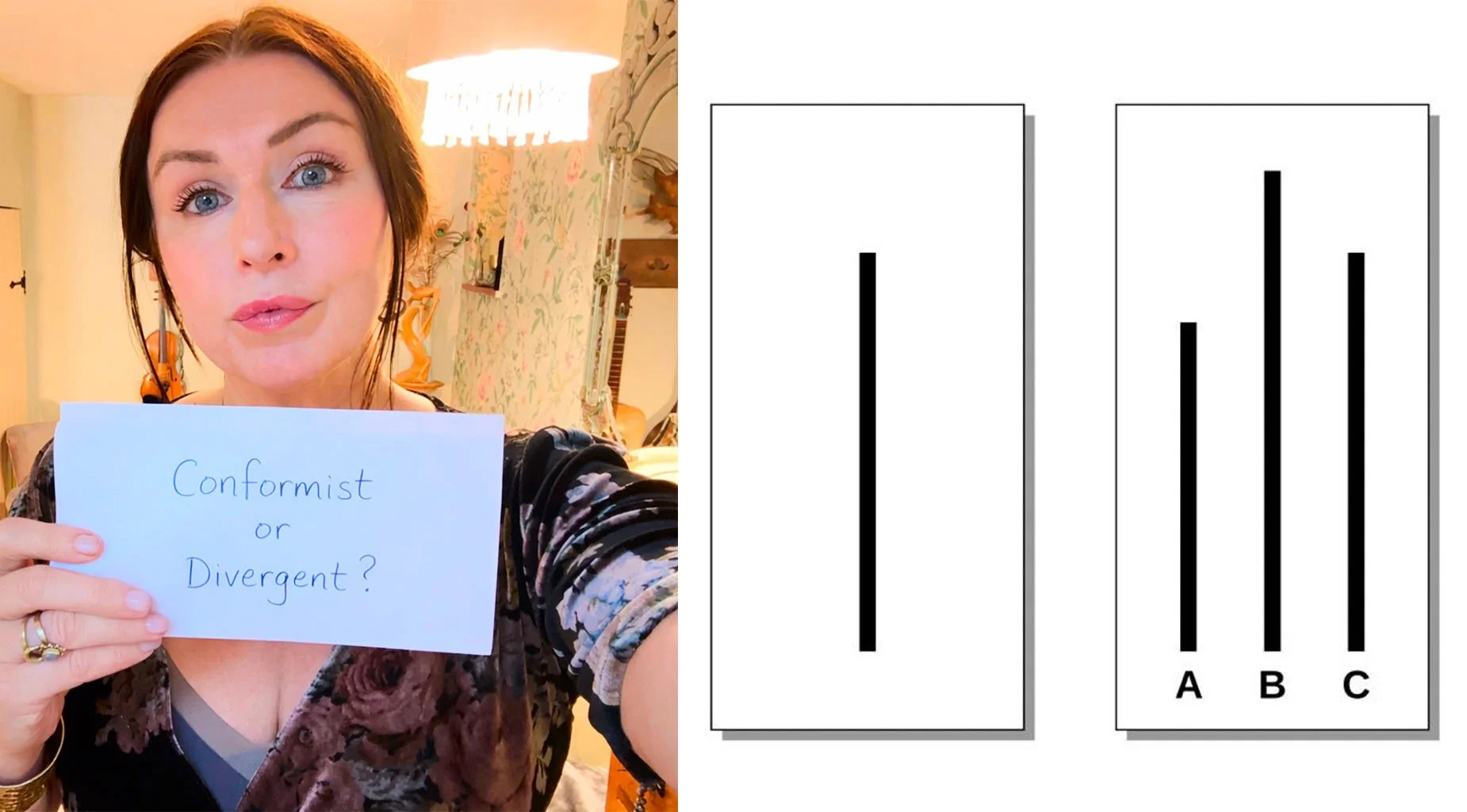
Asch tested this over a series of studies in the early 1950s, using a simple task: 123 male students were shown two cards, the left card showed a single line, and on the right card, there were three lines - they were asked which of three lines on the right was the same length as the one on on the left. The task itself wasn’t intended to be challenging; in fact, the correct answer was obvious.
Each person answered 18 times, on 12 of those, everyone else in the room (who were secretly actors) deliberately gave the wrong answer out loud before the real participant spoke.
When everyone else agreed on the wrong answer, the real participant also gave the wrong answer about 37 percent of the time. Three out of four people went along with the group at least once, even though they could see the answer was wrong.
Simply put, the study showed that three quarters of people will conform to group-think, even when they know it’s wrong, and that this happens, on average, at least a third of the time.
I imagine many of you reading this are nodding sagely, perhaps recalling Covid, Brexit, or Trump or one of the other contentious unfoldings of the 21st century, and how other people behaved. I suspect too, that you’re not including yourself in that 75% of people who conform to programming.
And maybe you’re right, and if so, perhaps that isn’t random, it’s destiny.
Let’s look at three gems from this research that I didn’t speak about above but that particularly fascinate me, and point to the soul-deep truth it illuminates:
1. Why did participants give the wrong answers?
Firstly, most people later said they knew the group was wrong and went along simply to avoid standing out.
Participants reported they conformed because they did not want to be “different from the group” or “conspicuous”.
There was a smaller group who said the wrong answers for a different reason: when they heard the actors giving the wrong answer, they wondered if they’d misunderstood the task or if their eyes were deceiving them, saying that the group made them “begin to doubt their own perception”.
Also remember this study was based on a very simple task - not one that should have been hard to know and trust they had the right answer to. And yet, even so, participants doubted themselves.
In the real world, the dilemmas we face are rarely so simple, and so the right answer might not be obvious, additionally the stakes are often higher than looking silly in front of a few strangers, therefore the potential for being swayed by others is perhaps even greater.
People will *knowingly* do wrong things, if the group is doing them first.
2. Did everyone follow the crowd?
As you might have already deduced from the numbers I shared above: one in four people never went along with the group at all.
In the face of the rest of the group giving wrong answers, they were not swayed to join in.
One of these participants afterwards said he felt “a sense of satisfaction” that he had resisted the pressure to go along with the rest.
It seems just as there’s a majority of humans who will conform, no matter whether it means choosing the wrong answer (or doing a wrong or maybe even bad thing), there’s a divergent minority who won’t.
3. But if it’s only a minority of us who will do the right thing, isn’t that pretty bleak?
Here’s where I lend you my rose-tinted specs to see the most beautiful part of all of this.
In a twist of the original study method I described above, in some of the tests, one of the secret actors chose the correct answer before the participant took their turn.
The study showed that even when just one other person in the room answered correctly, participants’ wrong answers fell to 5 to 10 percent.
What that showed is that just one dissenting voice can dramatically change how others around them will respond.
Of course in the real world, the dissenting answers don’t belong to actors, they are the voices of the 25% of us who are divergent, and who will see and speak the truth, no matter what is happening around us.
And that will have a powerfully liberating effect on those around us, as we collectively move deeper into these troubled times.
As Clarissa Pinkola Estés said:
“One of the most calming and powerful actions you can do to intervene in a stormy world is to stand up and show your soul. Soul on deck shines like gold in dark times. The light of the soul throws sparks, can send up flares, builds signal fires, causes proper matters to catch fire. To display the lantern of soul in shadowy times like these - to be fierce and to show mercy toward others; both are acts of immense bravery and greatest necessity.
Struggling souls catch light from other souls who are fully lit and willing to show it.”
On Friday 30th January ‘26 at 2.30pm I’ll be going live on YouTube to explore further…
How to know if you’re a divergent one.
What is being asked of you?
What might it cost you?
What do you need to be able to follow your soul path, particularly when it calls you to diverge from the masses?
How can you stand up and show your shining soul?
You can find all the details to join me here.
All my love,
Lian ♥️
Want to become more intimate with us? If YES, click any or all of the buttons below.